
Question Bridge
Homage to OMCA / Blowing Bubbles

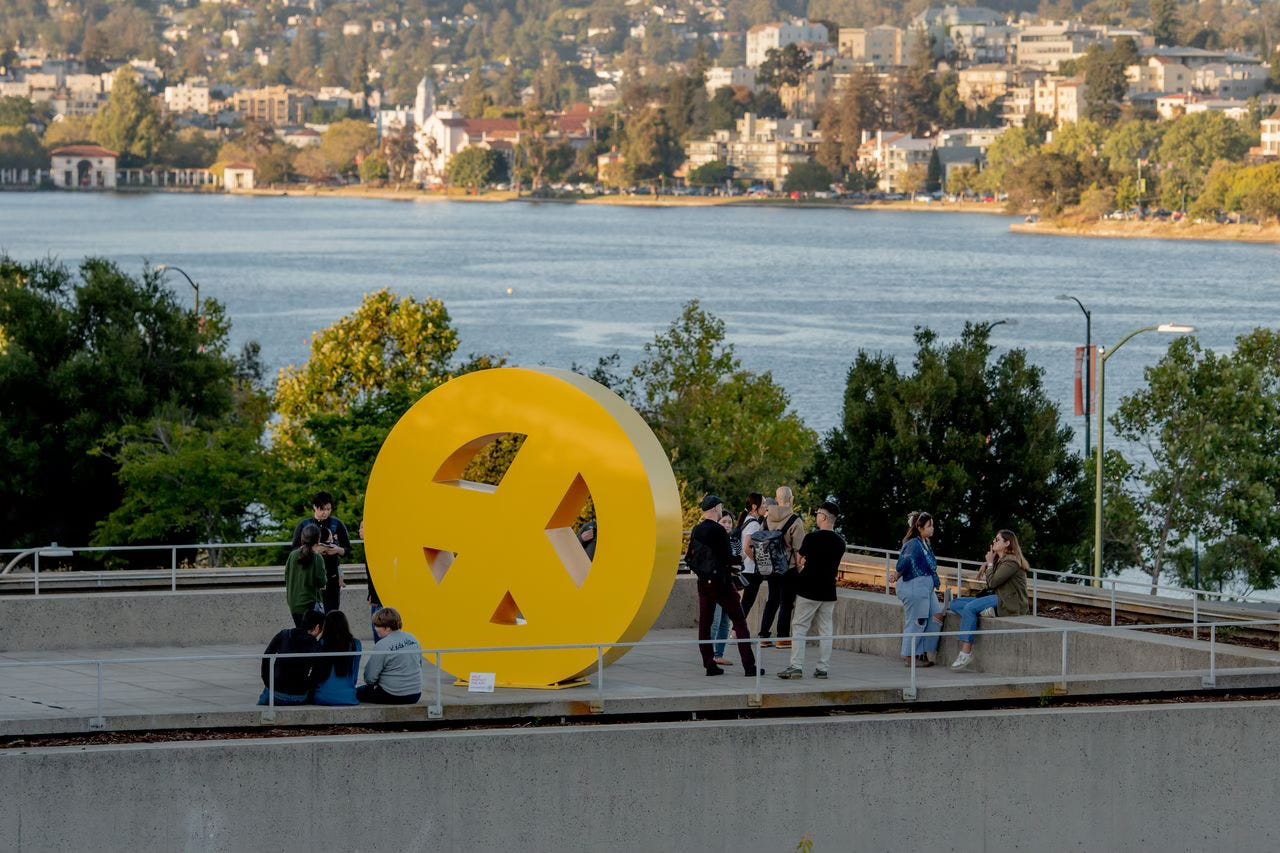
Anyone who knows me knows that I love Oakland... love it despite its sacrum-shaking potholes, shattered car windows and homeless encampments. Quite a sales pitch, I know. Nonetheless it’s one of the most international and integrated cities I’ve ever seen, and I admire its scrappy activist role in Bay Area art and politics.
Among my favorite places in Oakland is OMCA: The Oakland Museum of California, housed in a sublime mid-century modern building designed by Kevin Roche that opened in 1969. The museum celebrates all things California: its history, natural world and fine arts. Some of its major exhibitions have included The Gold Rush, the Black Panthers, the Art of Pixar, lowrider motorcycles and Burning Man. And OMCA remains unapologetically community-conscious (a term I prefer to “woke”), often focusing on the experience of Black, Hispanic and Indigenous people throughout California. OMCA is also known for its lively Dia de los Muertos celebration, held in the outdoor sculpture garden overlooking Lake Merritt and the downtown area.


A few days ago I wove through the Museum‘s visual art galleries, revisiting the works in the permanent collection. There’s a spectral variety of California artists on display, and a large satellite gallery devoted to the works of documentary photographer Dorothea Lange. A smaller gallery features the work of “self taught “artists, none of whom had any formal art training, and some of whom are developmentally disabled.


There’s a lot to see. But the single artwork I find most magnetic is at the very back of the galleries, behind the Art Deco and stained glass, in a darkened room with six video screens. This is where you’ll find Question Bridge, a project by Chris Johnson and Hank Willis Thomas in collaboration with Bayeté Ross Smith and Kamal Sinclair. Completed in 2012, it premiered at Sundance the same year.
The six screens portray informal Q&A sessions between young Black men and their elders — more than 150 men in all, their 1,500 exchanges recorded in San Diego, Chicago, Atlanta, Birmingham, New Orleans, New York, Oakland and Philadelphia.
It’s a simple but powerful conceit: A young man asks a question about Blackness; a series of older Black men from all walks of life – some incarcerated – provide unrehearsed replies. The questions range from the profound: “How does it feel to see someone lose their life?” to the comical: “Am I the only one who feels uncomfortable eating chicken, watermelon and bananas in front of white people?”
The premise of Question Bridge is as compelling as it is simple. Leaving the exhibit, I wondered: What would people ask me if they were genuinely curious about experiencing Parkinson’s, and wanted an honest and candid answer? To that end, I have decided to follow Question Bridge’s lead. If you have a question, please post it in the Comments section or email me directly. I probably won’t be able to answer every question (I hope there are that many!), but I’ll do my best.
Meanwhile, I already put that offer out to a small group of friends, and I’m going to run with it.
How are you doing? Really?
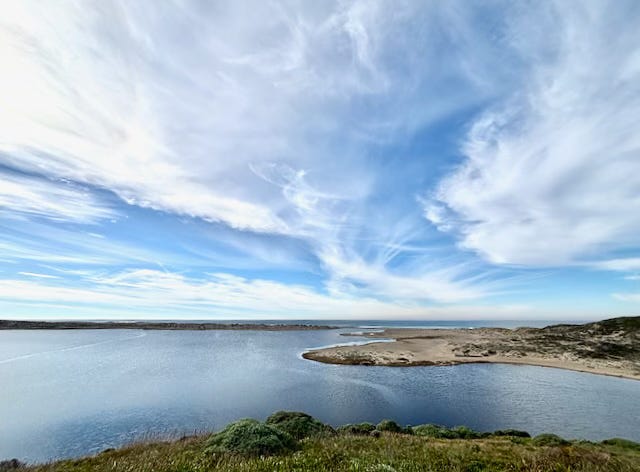
I’m doing OK, considering. Trying to take it one day at a time. I’m obsessed with keeping up with my exercise, which means riding my bike five days a week, ping-pong on Wednesdays, Pilates on Mondays. But no matter how much I do, I always feel I should be doing more. I’m shamed by PD persons who spend hours every day running, boxing, dancing or on the treadmill. Most of them, I tell myself, must be retired... The strange thing is that, socially speaking, I’m doing almost everything I was doing before my diagnosis, except for hiking (I did manage a short one, out to Abbott’s Lagoon at Point Reyes, during the holiday weekend.) But everything takes more effort, and there’s some anxiety involved with juggling my commitments.
Do you feel angry that this is happening?
No, I agree with the Dalai Lama, who once said that getting angry is like turning up the fire under an already boiling kettle. Most of the time I feel some combination of frustrated and frightened. Some things that were mindless a year ago – simple things like buttoning my shirt or tying a double knot in my hiking shoes — now take more concentration. Sometimes I’ll find it amusing, and just shake my head like, really? But I never feel like I’ve been singled out for some personal plague. Why me? Why not me? I just hope that this is all there is for a while. Having PD doesn’t exempt you from other dread diseases.
You said that you were frightened, are you just frightened about getting worse as time goes by?
Of course, yes. Because I can feel the progression unfolding in my body and to a lesser degree in my mind (e.g., I now content myself with “amazing” at Spelling Bee). My symptomology is more pronounced than it was even four months ago, and when I project into the future – like my upcoming trip to Florida, or fulfilling my desire to visit Europe again – I have to admit to myself that everything is aspirational. I don’t really know what I will or won’t be able to do even a few months from now.
What’s the hardest part about all of this?
Doing it alone. I’d feel less trepidation if I had a partner, somebody as committed to my well-being as I was to theirs. On the other hand, the presence of a witness might have the effect of encouraging me to complain more than I already do.
Some friends who believe in magical thinking have suggested that I declare myself on some of the dating apps, but I’ve been hesitant. Woody Allen joked that he wouldn’t want to belong to a club that had someone like him as a member; it’s sort of like that. What kind of person would seek to be in a relationship with someone (albeit not just any someone) who has a degenerative neurological disease? Well, they might be a bodhisattva… or at least someone for whom my gifts and humor are sufficient to offset the challenges, present and pending, that my situation entails.
Are you doing anything besides taking your daily doses of dopamine? Are there any alternatives that actually work?
Who knows? But yes, I’m trying a boatload of supplements. Black seed oil, flax seed oil, vitamin E, vitamin B... My cupboard looks like a pharmacy. Are any of these doing me any good? I can’t say; there’s no “control” Jeff to compare myself with.
As for some of the other much-touted devices, who knows? I just applied to be in a trial with the “vibrating glove“ developed at Stanford and Rice, which has had good results in clinical trials. So strange. It seems to have vibration in common with the BeechBand, which hasn’t done me noticeable good. Then there’s the red light wavelength helmet which I described in the last Substack (and which one very generous subscriber offered to gift me). It may or may not work; the results of the trials have been mixed. Might it work for me? Sure it might. Will I give it a try at some point? Yes, probably. But I’m hoping to be admitted to the study with the glove, which seems more legitimate and hopeful than those other devices.
Has your spiritual practice become more pronounced?
Yes, since the Nepal trip I’ve been sitting every morning and letting my mind clear as best it can.
What has come from this experience that has surprised or delighted you?
You’re looking at it!
Well that was interesting. I’m sure your questions will be, too.
As always, thank you so much for reading. And before I go, a recommendation:
The work I do with Ethical Traveler, the non-profit travelers’ alliance that I co-founded in 2003, was sparked into being by an Op-Ed I’d published in the Washington Post on July 25th, 1996. Titled Burma: No Place for Tourists, it urged travelers to heed imprisoned Burmese leader Aung San Suu Kyi’s request, and forego visiting her beautiful country until the brutal authoritarian junta had been deposed. Thirty years later, Burma (now Myanmar) is still under the grip of a military dictatorship.
Bangkok-based filmmaker and activist Jeanne Hallacy has for many years been a tireless campaigner for autonomy and human rights in Myanmar. Her new film, Thabyay: Creative Resistance in Myanmar “follows four democracy revolutionaries who are finding creative means to fight against the military junta. Some take up arms while struggling to stay true to their commitment to non-violence, while others engage in ‘artivism,’ using music, poetry, and art to bring about a peaceful, free, democratic, and truly inclusive future for all people in Myanmar.”
Ethical Traveler’s co-founder, Gregg Butensky, is the film’s Producer.
There will be a free screening of Thabyay at 5 p.m. on February 6th at UC Berkeley, and on the same day in Amsterdam (and I know a few of my subscribers live there!). I urge everyone to see it, and to join Jeanne (in Berkeley) and Gregg (Amsterdam) for a discussion afterwards.
And while we are on the subject: This post is dedicated to the memory of Renee Good and Alex Jeffrey Pretti, and in support of the brave people in Minneapolis and around the country who are standing up to the authoritarianism, corruption and cruelty that define this sickeningly un-American presidency. I share my sincere hope that our own resistance movement will swell and grow stronger during 2026.
Thanks for reading.
In the spirit of the Parkinson's Question Bridge, I'd like to ask what you've found the most helpful--physically, emotionally, mentally and/or spiritually--in regards to various forms of support you've received from friends and family. What kind of support could you use more of from your people? Is there anything that you don't want to ask for, but would love to have folks offer to do for you?
Thanks for the shoutout of our film, Jeff - and for another powerful post.