
Glow
Beauty and Value / Chicken and Egg

“Every picture has its shadows
And it has some source of light…”— Joni Mitchell, from Shadows and Light, 1975
I’ve been writing about light lately, so when I heard that the Exploratorium is featuring a temporary exhibition (through January 25th) called Glow I was intrigued. Who doesn’t love light-based artworks? Having missed the Lightscape at the San Francisco Botanical Garden, I was curious to see what kinds of strange new visions the Exploratorium’s curated artists had to offer.
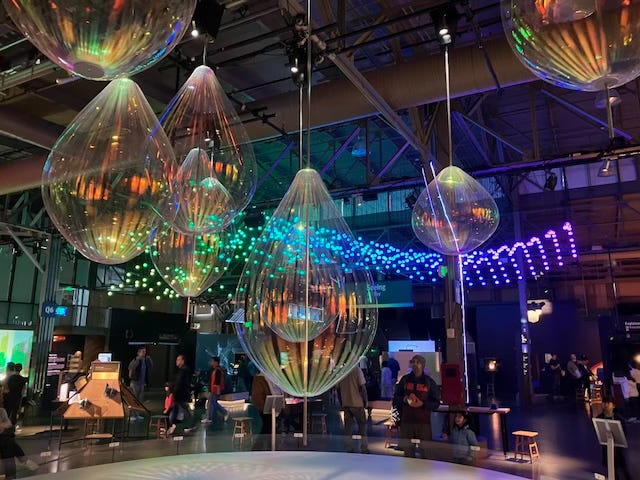
For those of you who haven’t been there, the Exploratorium is a immersive science museum that was created and opened by Frank Oppenheimer, the younger brother of J. Robert Oppenheimer, in 1967. Both brothers had worked on the Manhattan Project, and both had a hand in developing the atom bomb. But while guilt and public scandal more or less ate J. Robert alive, Frank decided to put his energy into creating something of beauty and value that would last beyond his time and inspire future generations. The Exploratorium is such a place.
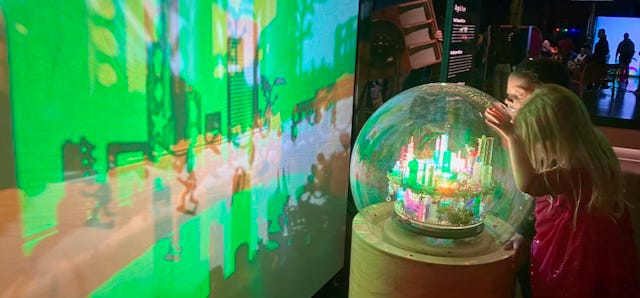
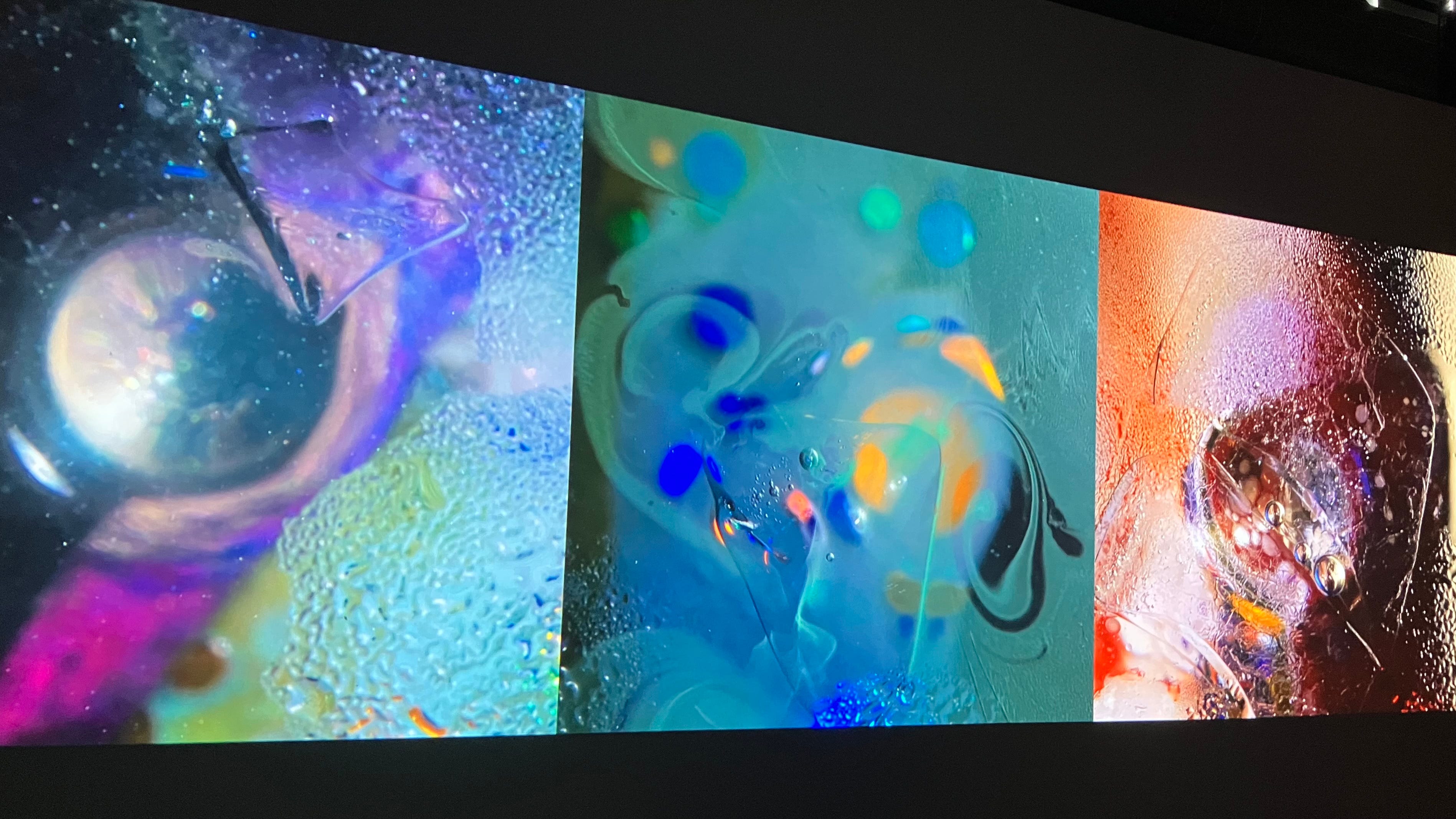
I arrived on a Tuesday during winter break, and the place was mobbed. By the time I reached the Glow exhibits I was exhausted, but managed to see seven of the eight featured artists. All the works were luminous and interesting, but like so much art made of LEDs and circuits, most seemed somewhat soul-less to me. One exception was Akiko Nakayama’s 2024 “Alive Painting,” entitled The Thawing of... Composed of three screens aligned in a darkened room, the eight-minute film showed various materials in states of evaporation, sublimation, and metamorphosis. The colors and ever-changing shapes were mesmerizing.
A little card offered a quasi-explanation: “(Nakayama) uses water-repellent acrylic paper, Petri dishes, sand, and other materials as a base and then drops or pours ice, oil and, bubbles onto the landscape… Each performance is unique and accompanied by a musical score.” Dynamic and hypnotic, it was the one exhibit that provoked an emotional reaction in me — maybe because I feel that I myself am entering a stage of transformation, of melting.
One evening last week I was at a dinner party, lighting the Hanukkah candles with a group of friends. Afterwards we went around the table and talked about subjects light and dark. One friend suggested that darkness is the context for light, and vice versa; without darkness, light would be meaningless; just an endless glare all around us. We agreed that darkness is something to be treasured — as it is in International Dark Sky Communities like Flagstaff, Arizona and Bee Cave Texas — and simply when where we’re trying to sleep.
Yes, darkness is exquisite, and essential. But there is a darker side of darkness, one that’s been haunting me since my return from Nepal.
During the past month I’ve found myself confronting two notorious symptoms of Parkinson’s, which I’ve more or less held at bay since my diagnosis in 2021: depression and anxiety. Both evoke the “chicken-or-egg” dilemma. Are they caused physiologically by Parkinson’s? Or is knowing you have Parkinson’s their cause? While depression is a well-known symptom of Parkinson’s, it’s also a reasonable reaction to having Parkinson’s. But paired with anxiety, the depression has an energy and edge that’s pervasive.
We don’t like to talk about this very much — “we” being those of us with Parkinson’s — especially now. After all, it’s the holiday season: a time of celebration, love and light. Depression is by definition a downer, and I don’t want to de-stripe anyone’s candy cane.
As a group of my close friends gears up to gather in Sedona for our annual New Year’s get-together, I’m trying not to let dark thoughts cloud my equanimity (see my Substack post of June 2024). But they are difficult to push aside, given my increasing issues with walking (I shuffle a lot more than I used to) and the discombobulation I feel when in a group of more than eight people (Sedona will be twelve!). So it’s been a standoff during these post-Nepal weeks. I feel a deep sadness lodged in my chest, and a creeping current of anxiety about the future.
Friends who know me well suggest that this is a good time for my Buddhist practice to kick in. I do meditate every morning, and have since my return from Nepal. It’s helpful while it lasts, but when I open my eyes afterwards the world floods back. One friend suggested I try looking at the depression through the Internal Family Systems Model, and give the depressed part of myself a name (e.g., Fred). This might help distance it from my mainstream consciousness — so that when it appears I can call it out: “OK Fred, I hear you. You’re my aspect of depression. But there are other aspects of myself that are stronger, and I’m going to let them take over. So please step back.”
So what’s the antidote? Well, literally and figuratively, dopamine. I get mine, not only in pill form, but from the company of other people; friends who sit close by, and understand what I’m going through. Sometimes I’ll just put my arm around their shoulder, because human touch is one of the best sources of that chemical. Would it be even better wrap myself around someone at night, and stay that way until morning? Of course it would, but that’s not happening for me at this moment.
So I climb into bed, read a story or two in The New Yorker, lay my head on the pillow, and wake the next morning to whatever small victories might await me that day. Writing these posts is sometimes one of them; it’s personal proof that my cognitive abilities, though I feel them declining, are still sharp enough to write something more or less coherent.
Maybe it all comes down to what Jane Fonda spoke about with Tanya Mosely on a recent episode of Fresh Air: Resilience. The ability to bounce back, and find love – and dopamine – where you can.
Given the tension in this post between light and darkness, I find it very interesting that one of the solutions to Parkinson’s, at least symptomatically, might be found in light itself. Recently I’ve been doing some AI-assisted research on red light therapy, a very promising treatment that has actually undergone clinical trials with positive results. Symbyx Biome, the company that conducted the trials, is actually selling the red light therapy helmets they used for the not unreasonable price of $1,100 — well worth the investment as a possible first resort before DBS (Deep Brain Stimulation). So I’ll either be saving up early this year waiting until next Christmas to try on my very own helmet. Promising treatments using red light therapy are also in Stage 3 clinical trial phase with a device called Celeste, currently being tested by PhotoPharmics.
Maybe it’s best to end this all-over-the-place entry on that optimistic note. Thank you all for reading. I hope that whatever might be stuck inside of you thaws, and that you flow into the New Year with happiness and ease.
Oh my friend, my friend. Dear brutiful Jeffji. Does IFS teach you to shit-talk Fred like that? Telling him to shut up and scram lest he get his whiny little ass kicked by your more macho selves...? Is the point of IFS to bully yourself?
I dunno, just a silly thought...but... what if you recognized Fred not as "depression," but as grief? What if Fred were a dear friend of yours who had just lost something deeply precious to him? How would you talk to him then? Or would you maybe give him a hug and a nice hot cup of tea? Show the guy some love?
Wishing you self-compassion.
Reading your post, I felt like I really settled into my body, and sensed yours over there across the bridge. That's what your writing does: lets people feel all of themselves, even the lugubrious Fred piece, and also gives them access to a beautiful soul that's honest about what he's going through. I wish you light, and I thank you for this post. I can't wait to hear about the red light helmet. Maybe you should do a go fund me campaign and get it sooner rather than later.