
Up in the Air
The Friendly Skies / I'll Fly Away

All of the photographs in this post, except as noted, are © by Laurel Ramey.
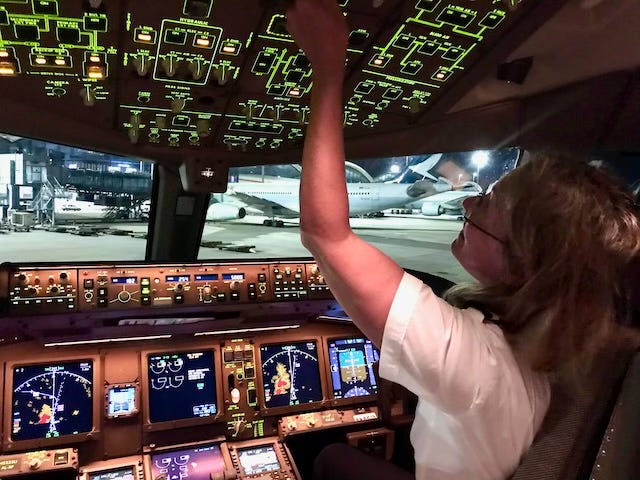
One of my superpowers, for which I’m especially grateful, is the ability to make new friends — not a skill in everyone’s wheelhouse, especially later in life.
There was an irony to how I met Laurel Ramey. It happened last August, at the annual Book Passage Travel Writers and Photographers Conference. I was signing copies of The Size of the World, the 30th anniversary edition of my book about circumnavigating the world by land and sea, without airplanes. Laurel handed me her copy. We struck up a conversation, and agreed to meet for lunch in the East Bay.
I’m not sure it registered with me during our first meeting at Book Passage (I was totally distracted), but it certainly did at our lunch in early October. Laurel is a pilot with a major airline, and routinely flies large jets over the Pacific to destinations in Asia. She’s also a marvelous photographer and writer, as evidenced by Conversations in Motion, her own Substack meditations.
After reading some of her posts — particularly the ones about the Ajanta caves and Northern Lights — I thought it might be interesting to get a long-haul pilot’s perspective on travel and travel writing. And, of course, I was curious to learn about the arc that had carried a young woman from the Midwest into the cockpit of a Boeing 777 (among many other aircraft).


Can you give me a capsule summary of how and where you became a pilot?
It was a long process. I grew up in Indiana, in a World War II family. My dad took me to the local airport as a kid to look at airplanes. He had three brothers; they talked about airplanes, and flew some themselves. One of them was a pilot in World War II and was killed.
But all the boys went off to war. And so I grew up with them talking about airplanes. I think that I always loved airplanes, but I didn’t think it was accessible to me in the Midwest at that time, until I went to college. I met some people who were pilots, and took my first flight there. But even then, it took time ‘til I had money to fly, so I kept finding aviation-related jobs and picking up any flying time when I could. I was always interested in the mechanics of things, so I finally decided to go back to school to get certified as an aircraft mechanic. Then, I got hired with a large flight school as a mechanic and was able to continue my flight training through a discount program for employees.
How long have you been with your current airline, and what routes do you mainly fly?
I’ve been with them for 11 years, and my route changes every month. I particularly enjoy flying to Asia. I can’t always get those flights, but that’s what I try to do.


You once told me that your favorite aircraft to fly is a 757.
Yes! But I’ve loved every airplane that I’ve flown! Some have been more challenging to deal with than others, and some of them have had more quirks than others, but I’ve loved every airplane from the very first airplane that I flew.
About how long do you generally have on the ground between flights?
For an international flight, it’s usually somewhere in the realm of 24 to maybe 28 hours. And that does not include the van time to the hotel.
What do you generally do with that time?
Once I’m on the ground, I need a nap, but I try to explore as much as I can. I like to try local places, new foods and I want to see something I haven’t seen before that’s either historical or cultural. I also love just wandering the streets and trying to get a feel for people and their neighborhoods.
Going to Lantau Island — the first time was on my own and the second time was on an overnight. That was a bit of push energy and time-wise, three trains, I think, and a gondola ride.
What are some of the most wondrous things you’ve seen from the cockpit?
The Northern Lights, for sure. Another time was coming back from Europe on one of my first international flights, and seeing the sun rise over New York City. But honestly, every time I look out the window, I think there’s something pretty magical. Every flight I find something like that.


How has being an airline pilot changed the way you see the world?
The first fundamental thing I noticed about how it changed the world is perspective. When I first learned to fly and was in the air, I noticed that there seemed to be more room between me and all the little problems I had, all the concerns. Balance is another big one. I think that I — and quite a few other pilots I’ve talked to — got into this originally because of the joy and the freedom and the expression that flight offers. But as you go through your career, it becomes more regimented. There are more rules, you’re carrying passengers, there are more concerns, more complex aircraft. So it starts as a right brain type of activity and goes into a left brain activity. Learning to balance those two has taught me quite a bit.
And how has it changed the way you write about the world?
From those same things. I think pilots carry this natural humility with them. I don’t want to speak for everyone, but I am learning constantly, and there are always challenges. I know a lot, but at the same time, I don’t know everything. And I’m always keeping an eye or an ear out for the things that I don’t know.
Your Substack blog, Conversations in Motion is a labor of love.
Yes.
What are you trying to convey in those posts?
Connection. That we all share common experiences; that we all have more in common than not. And we have a connection with history and the past as well. Those are things that are important to me. Connection, more than anything else.


Might there be a book in there somewhere, and if so, any thoughts about how you would tie it all together?
I would love to do a book. At this point, I have so many different ideas floating around my head I’m having trouble focusing them. But I’d like to write more about what aviation has taught me, how it has changed my life. I’ve always said that aviation is an analogy for life. I used to ask my students when I was flight instructing, “Are you flying the airplane, or is the airplane flying you? “ I’ve learned so much from airplanes. I think I’d like to mesh together that connection with what airplanes have taught me, and how that plays out. I’d also like to write about the people I’ve met and the impact they’ve had on me, from my first flight instructor until now, all along the way there have been interesting, fascinating people with compelling stories.
Do you have any life goals or aspirations at this point in terms of your writing life and/or your career as a professional pilot?
I feel so grateful for everything I’ve gotten the chance to do — it’s been beyond my wildest dreams.
Specifically to aviation, I love classic airplanes and engines — so I’d like to dust off my tools and tinker a little bit; I’ve always wanted to restore an airplane. I want to do some more teaching. I’d like to fly an AT-6: an aircraft that was one of the Advanced Training airplanes in the World War II military program. It has a big ‘ole Pratt & Whitney 1340, and it sounds amazing — I’m addicted to the sounds of round engines. I worked on one of those when I was in aircraft mechanic school, and I fell in love with the airplane... because I fall in love with all the airplanes. I’d also like to fly a DC3, which is an early transport category airplane.
But more than anything, I want to write about my experiences and what aviation (and the world) have taught me.
Thank you, Laurel.
So welcome to 2026. Once again I spent New Year’s in Arizona with a group of friends, many of whom I’ve known since the early 1980s. We’ve carried on this tradition for nearly 30 years, with the past few spent at this beautiful location in Sedona.


Some of these folks have traveled with me in Nepal, through Tibet, and even across Kazakhstan and Uzbekisthan. They knew me as a different person from the figure I cut today. I can’t help but wonder how my newer friends see me, given my compromised state and self-consciousness around the way I now walk, verbalize and cognate. It’s almost as if they are entering a relationship with a completely different person than my Sedona friends have known.
It’s hard to digest this. My new friends read my books, and are aware of what I was once capable. It’s hard to imagine how they see me now, unaware of what they are missing in terms of the energetic hiker, explorer, conversationalist, performer, and lover of years past. Oddly, they seem as comfortable with me as I now am as I am uncomfortable with who I am not.
One of the challenges lying ahead for me (and in the present moment as well) is to befriend the disabled traveler and writer who greets me every morning with a stiff back and shuffling gait. It don’t come easy. In some strange way, I keep waiting for the former version of me to return; as if that Jeff were simply away in a remote part of the globe, due to return at any moment and tap me on the shoulder. “Hi, I’m back!“
I was just out on my daily bike ride through the cemetery, listening to the current podcast of the Ezra Klein Show. Klein spoke with M. Gessen, a New York Times opinion columnist who grew up under communist rule in the Soviet Union and reports frequently on regime change and political injustice. During their conversation, I recognized an allegory for what I’m experiencing, playing out on a larger stage. Listening to their appraisal of recent events – Venezuela, the murder of Renee Good, etc., etc. – I was filled with a grim realization; one many of us have felt since last January: I am no longer living in the country I was born in, the country I grew up in. It’s as if we’ve split off from our appropriate timeline (one in which both Al Gore and possibly Hillary Clinton were president) and veered off into a bleak alternate universe.
That’s very much how I feel about what’s happening to me physically. I’m no longer in the safe, familiar body I grew up with and lived in. And as with the United States in January 2026, I’m but vaguely optimistic that there will be a pathway for me to return to where I was, not very long ago.
So I slip on the BeechBand, take my Black Seed oil capsules, read up on the SYMBYX red light therapy helmet, peruse the scores of glacially slow clinical trials and wonder if there will come a day, within my lifetime, when I meet that man again. It’s hard to let him go.
But let him go I must, and take some comfort from the fact that even now, as a solitary 72-year-old writer and traveler with PD, I somehow remain interesting and attractive enough to draw fascinating new friends into my orbit, and to enter theirs. As always: much to be grateful for.
Best to end there. Thanks, as always, for reading.
As a pilot myself, really appreciated the observations that one always continues to learn about flying and that flying teaches us about life itself. Mickey Gaynor
Ji ~ You will always be interesting and attractive, however much your body deteriorates. It is impossible for you to be anything but; your mind, storytelling, writing and life experience make you inherently and inevitably interesting and attractive. Big hug and happy 2026 from Baja and from this long time “groupie” who remains and will sustain as one of your biggest fans. Keep writing, keep riding your bike, keep going physically, no one cares if you stumble and fall, you’ll make it into a poignant piece of writing, of that I’m sure.